Deconstructive Diva
By Lars Bukdahl. Translated by Anne Born
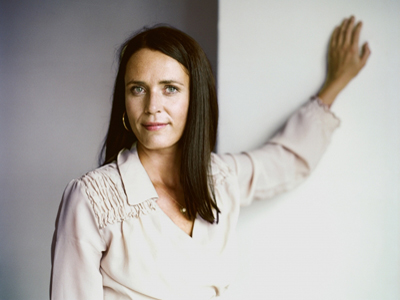
Mette Moestrup (b. 1969) made her debut in 1998 with the quietly mumbling poetry collection Tatoveringer (Tattoos) which in 2002 was followed by a very different, enthusiastic and extroverted collection Golden Delicious; her great breakthrough arrived with Moestrup’s third book, Kingsize, in 2006, a powerful presentation of quality, which deservedly brought her the Montana Prize for Literature.
Moestrup holds a degree in the history of literature and is one of Denmark’s leading Rilke experts, and, as she writes in the poem ‘A Bite of the Banana’: ‘Call me intellectual, I do it myself./ I can take it.’ And the most delightful thing about her poetry is that she does not distance herself from intellectuality, but firmly interweaves it into a brilliantly mastered, traditional poetic practice: harmonious: musically existential pain, and a playful intercourse with (traditional!) avantgardish strategies, such as pastiche and the ready-made.
One poem refers to the children game of ‘Mess-Mother’ in which the players entangle themselves with each other really thoroughly, and Kingsize as a whole and, now and then, the individual poem may well also seem like a refined and hilarious round of ‘Mess-Mother’ for 1 sharp intellectual, 1 sensitive main poet and 1 crafty avantgardist, all by the name of Mette Moestrup: 1,2,3, tangle!
In the poem or text ‘We Humans’ is it ‘only’ the intellectual and avantgardist who coil themselves together: The list of exotic racial features take her verbatim from the book by the Danish anthropologist Kaj-Birket Smith’s book We Humans, 1946, is expanded and undermined with examples of ‘Danish’ racial features and in a strange way the text turns into both a tart racism-satire and a reversed utopia about community: Pocus Hocus!
“I have always worked with the performative aspects of reading for an audience, and recently I have started to co-work with a musician, we dig weird, organic, computer-manipulated sounds, beats, and our motto is: aggression and fun. We call ourselves SHE’S A SHOW.
I have an academic background, I studied literature for many years, a highlight was a course by Edward Said himself at Columbia University. I dropped out of a ph.d. back in 2001 in order to, well, live as a poet. Theory still means a lot to me, but I use it very idiosyncratic. During the years, I have teached a lot at different Scandinavian Writer Schools in Denmark, Norway, and Sweeden. Right now, I am working at Litterär Gestaltning in Göteborg, Sweeden. I like to work with different people in different contexts. I have participated in many poetry festivals – especially in Norway and Sweeden, but also in Germany, Estonia, Island, Finland and Greenland.”
We humans
Hair types
Hottentot Cross-breed from South Africa. The typical, woolly ’Peppercorn Hair’ is genetically dominant and hence has been preserved despite the Admixture of European Blood. Vedda from Ceylon. The curly Hair is characteristic both of Australians and the European racial Group. Yámana woman from Tierra del Fuego with the Indians’ coarse, straight Hair. She also presents the Appearance of the primitive Indian Lagoa Santa Race. Dane with the standard ’mousey-brown’ Hair.
Special Physical Features
Pygmy Women from the Ituri Rainforest and Countess N. Ahnfeldt-Bille with ’Saddlebag Thighs’. Hottentot woman with ’Fat Buttocks’. Eskimo Woman from the western Coast of Hudson Bay with childlike (infantile) Features. Together these Pictures show the Female Types of four different Races.
Face Shapes
Chinese with the distinctive ’Mongolian fold’ which produces the apparent Slant of the Eye. Ovimbundu Negro from Angola, with protruding Jaw. Man from the Massim district of New Guinea. The Nose of the neo-Melanesian Race is often hooked, almost Jewish in appearance. Woman from Hvide Sande, Denmark, with ’Snub Nose’.
Abnormalities
Genetic Abnormalities are caused by Mutations and can occur among all Races. These pictures show Instances of Albinism and achondroplastic Dwarfism from New Guinea and Denmark. What cannot be seen in the Picture is the little white Woman’s tiny, black third Breast.
Mette Moestrup from Kingsize, 2006. Translated by Barbara J. Haveland
Red light
By Mette Moestrup. Translated by Claus Bech
Confuse not beautiful with gorgeous, suffer
for the difference. Like that between loving
and thinking “I love”. Avoid imperatives
such as: Love me. No
No one gets shy from being bitten,
and having loved just now
will never be the same
as loving right now.
We just love
to use words like love, beloved
oh, present, past, the noun, the possessive,
my love. If?
If not? I feel RED. red light
But LIGHTER is on my lips. red light
My lighter is red. red light district
And transparent. red light stop
I’m light not light tonight.
Feeling so grammatical tonight.
What is it you want? Would you like me
not to ask what you want?
This situation is out of control, this situation
Is not me, I just relate to it.
I´m bad at it and it makes me feel bad
like one (too many), a bad man,
livid in the face, swift-footed. But I realize
you’d understand me if you could, you know that?
I feel: red and my limitation, and red,
and that it’s mutual, and that there´s a difference.
“Do you love me?” “Yes.”
It says nothing about what yes means to you.